Color patterns
Banded fur, patterned and iridescent feathers, downy bases.
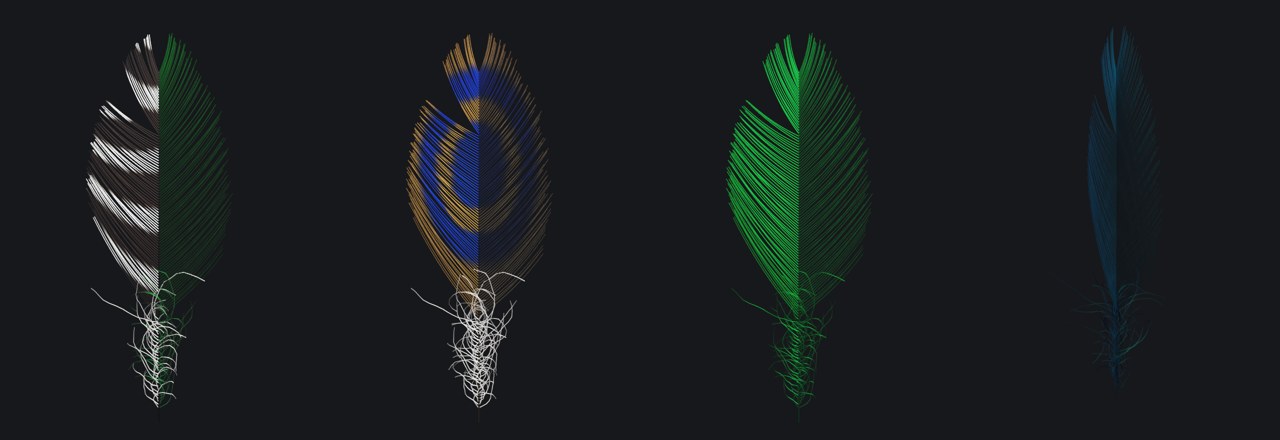
HairColor colors more than one tone a strand. Every pattern renders the same in Maya's viewport, the standalone app and Arnold, bakes into game cards and exports to Unreal.
Banded fur
Agouti, ticked, tipped and shaded coats: each hair changes color along its length.
bandAmountturns the bands on (0-1, mappable).bandMelanin,bandRedness,bandDye: the band's pigment, in the same terms as the hair's own.bandProfile: a ramp from root to tip, 0 the hair's color, 1 the band's.bandsrepeats it (ticked fur: three or four).bandJitterandbandWidthJittershift and stretch each hair's bands a little, so they never line up across the coat: what makes agouti read.- Guard hairs:
guardsis the share of hairs that take the bands and the tip; the rest is a plain undercoat (tinted byundercoatDye).guardsBypicks them at random or the longest. - A black tip is the tip color as before (
tipColor,tipAmount, atipProfilenear 1); a shaded coat is a long, soft tip profile.
The agouti_fur preset puts it together.
Feather patterns
After a Propagate, HairColor draws in each feather's own flat space: the feather laid out with its shaft up the middle. A bar crosses many barbs, each at its own place along the barb, which no along-the-strand color can do.
featherPattern | What it draws |
|---|---|
bars | Bands across the vane: patternCount a feather, patternWidth, patternAngle (tilt), patternSharpness |
chevrons | V-shaped bands mirrored across the shaft (patternAngle: the arms, try 30) |
spots | patternCount rows of spots, patternWidth their size |
fringe | The vane's edge: the last patternWidth of every barb |
eye | An eye spot at patternOffset along the feather; patternProfile makes its rings |
texture | Your painting: featherTexture is the feather laid flat (root at the bottom, left vane on the left, alpha where it covers); add featherTextureRight for one image per vane |
- The pattern's color is
patternMelanin,patternRednessandpatternDye(white bars: melanin 0). patternVanes: both, or one vane (left and right as seen from the vane's top, tip up).patternJitter,patternScaleJitter,patternRotationJittervary each feather, so no two match.- It works on scattered shafts, hand-placed ones and Split assortments alike. Put the HairColor inside a design's compound for one image per design.
A downy base
On Propagate, down (0.2-0.4) turns the barbs at the shaft's base into soft, curly down (an
afterfeather): downCount, downLength, downCurl, downFrizz. HairColor's
downColor and downAmount color them.
Iridescence
Structural color, not pigment: iridescence (mappable, per point) makes the strands shimmer
toward iridescenceColor when they face you, the hue turning by iridescenceShift as they
turn edge-on (on a feather, the vane's angle to the view). iridescenceOn limits it to one
vane, or to where the feather pattern is (or is not).
- Arnold: Create Hair Shader builds the same as a ramp on the camera's angle to each strand's normal (an approximation: within a few hue degrees face-on and edge-on). Arnold's hair shader renders the patterns' colors lighter and softer than the viewport does (it adds light scattered through many hairs); they sit in the same places.
- Game cards carry it in the Color map's alpha; Unreal strands as
groom_iridescence(and ingroom_aowith Iridescence as AO, which Unreal's Hair Attributes node reads). See Game export for the Unreal material.
The barred feather design (groomlab.add_feathers(groom, "barred")) is a barred feather with
a green iridescent outer vane and a white downy base.